If you read last month�s edition of Woods-N-Water you would know that this hunting adventure started in New Zealand hunting red stag. I harvested a 14 point red stag that scored 325 7/8 inches the second day of my hunt. I was now getting ready to leave for Australia and begin my hunt for water buffalo. After spending four days with Paul Bamber, I was scheduled to fly out of Wanganui airport at 7:00am the next morning.
About 45 minutes into my flight and 15 minutes from landing at the Auckland airport we were informed that the airport was fogged in (only the second time in the past few years this has happened and they were both my flights) and our plane would be returning to the Wanganui airport.
Fortunately I was able to get a hold of Paul and he drove me to another airport and after changing some flights I was on my way to Australia. I arrived at the airport in Darwin, in the Northern Territory at midnight. I got off the plane and the temperature was at least 80 degrees and it was very muggy. In Australia it starts raining in December, picks up in January and really doesn�t stop until April.
The next morning I caught my flight from Darwin to Katherine. Once I arrived in Katherine I was met at the airport by Niki Fullerton, the wife of my guide. Then we started on our 6-hour drive into the outback to our camp. It was very warm out, close to 90 degrees. I had already changed into a pair of shorts and a very light shirt. During the drive to camp I expected to see kangaroos everywhere, but I was informed that there isn�t that many in this part of the country. Of course, right after that, I saw one cross the road. The camp is right in the middle of Aboriginal lands. The camp is owned by an aboriginal family and is leased along with the hunting rights to Steve Fullerton my guide. About an hour before we reached the camp we had to cross the river at two different locations. At first I didn�t think we would be able to cross the river in the Land Rover we were driving in. In fact when we reached each location to cross I unhooked my seatbelt just in case the water was too high and I had to exit the vehicle while it was floating down the river. But I was surprised, in both cases the river was about 4 feet in depth and the Land Rover didn�t have any problem getting across.
I wasn�t sure what to expect once I arrived in camp as far as living conditions. Niki informed me that the camp had just recently been moved to a different location and they were in the process of setting up camp. We were 300 miles from the Katherine, and there was no electric power running out there. As we drove into camp I saw a couple of solar panels set-up, which were used to pump water from the well. I saw a very large water tank, two separate outdoor showers, several aluminum buildings and heard a generator running. I thought to myself that it was going to be more comfortable staying here than I had imagined.
After getting out of the vehicle I met Steve Fullerton, my guide for the next four days. After unloading my gear we sat down to a very tasty dinner along with a couple of very cold beers. I was informed by Steve that usually this time of year the weather is cooler and not as hot as it has been. Usually they don�t start hunting water buffalo until June. By then all of the rain they had received from the heavy rains for the past few months would have receded and driving in and out of the flood plains would be a lot easier. They also would have spent at least a couple of weeks setting fires to the grasslands. These fires would have generated new grass growth and would have brought the buffalo from great distances to eat the fresh grass. My hunt was going to start on May 16th. At least two weeks before they normally start their hunts. I had to schedule both of my hunts during the non- peak time in order to do both hunts back to back. If I had hunted red stag during the peak time in New Zealand I would have been too early for the water buffalo hunt. If I had scheduled my water buffalo hunt during the peak time I would have been too late to hunt the red stag in New Zealand. So far my plan was working well. I had scored on a very large red stag, I just needed a lot of luck and a good guide to be able to harvest a big buffalo.
A friend had informed me before I left on this trip that 7 of the top 10 most deadly snakes in the world live in Australia. I have never really been afraid of snakes, but it sure gave me something to think about. I did ask Steve about it, he told me no worries mate, if you�re bitten by one he would shoot me and that way I wouldn�t suffer very long before the poison could kill me. After he stopped laughing he told me that most of the snakes in the area had been killed after eating a poisonous frog that lived in this area. He did advise me not to pick up any frogs!! It certainly made one look ahead on the ground as they walked. I never did see a single snake while on the trip.
After dinner I headed to the aluminum building that I would be sleeping in for the next five nights. I was glad to see a fan in the room; the energy to run all of the appliances came from the generator. For being 6 hours from the nearest town this camp had everything you needed. The most important was hot water for a shower at the end of a full day of hunting.
My body was still on a different time zone and I just wasn�t sure which one it was. I awoke the next morning and after breakfast Steve and I headed out on the first day of my quest to harvest a water buffalo. Our plan was to hunt all day and we took our lunch along with us. Steve felt that with us hunting earlier than he normally does that the water would still be high and we would be unable to drive back into the flood plains. So we headed to another area where we hoped we would be able to see some bulls feeding close to the road for a stalk. Steve used this Toyota jeep as his hunting vehicle. I had never seen this type of vehicle before, but it looked a lot like the vehicle that was used in the movie called Hatari, staring John Wayne as a guy in Africa who captures wild animals for Zoo�s in the U.S. It rode and felt like a tank and could go anywhere.
It took about 3 hours before I saw my first buffalo. We saw several cows, but no bulls. I did see a lot of parrots. They were as common there as robins are in the Midwest. Black, white and blue were the most common colors. Most of the land there was very flat, but it had a lot of ground cover. A buffalo could have been standing 100 yards away from us and we would not have been able to see it because of all of the grass. The one thing that I noticed when we were packing our vehicle to leave that morning was that Steve brought 5 boxes of wood stick matches along with us. After a while I noticed Steve lighting the matches and throwing them out of the vehicle. I was surprised to see him do this and of course I couldn�t let this go by without asking him why. He told me it was their way of conducting control burns in the outback. Not only did it burn off all of the old growth, but shortly afterwards all new growth would start growing again in days. Not only did this prevent large fires from getting started, it also provided fresh grass for the animals that lived in the outback.
We were now in the early afternoon and the heat from the sun was starting to bake me. I drank lots of water and kept a good supply of suntan lotion on all exposed areas of my skin. I never realized that Australia�s weather was subtropical. Later in the afternoon we saw two different bulls, they both appeared very big to me but Steve said they were too small and we could do better. That night Niki made us a great dinner, after a couple of cold ones and listing to a radio station from Indonesia (it was less than an hour flight away) I decided to call it quits and head for my aluminum building and turn in for the night.
After breakfast on day two, Steve decided that we would try another area and perhaps try to see if we could make it into the flood plains. That morning it was hazy and a lot cooler. As we drove down another road we noticed several different bulls, but again Steve felt we could do better. Another species I saw a lot of were wild horses. They were privately owned at one time by the aborigines, but escaped and now ran wild. Steve decided that we would give the flood plains a try. After a couple of hours we reached a riverbed that didn�t appear to be too deep. Steve got out and walked up and down the river looking for what he thought would be the best location to cross it. He signaled for me to come to his location and showed me where another vehicle had tried to cross it and got stuck. If you get stuck in the outback you may have a very long walk ahead of you. There are no trees to hook your come along to in order to pull yourself out. Steve and I decided that we would not try our luck, even though he told Niki where we would be hunting, it would be hours after dark before she got to us. As we were driving out Steve turned toward his arson ways again and started throwing matches into the brush and starting small fires. He handed the matches to me and asked me if I wanted to light some fires. I told him at home this was a felony and I had arrested a couple of people during my career as a Conservation Officer in Michigan for doing the same thing!
He laughed at me and told me this is how things are done in Australia. I knew he was right but I thought I needed to get back at him at least once for one of the many jokes he had played on me so far during this hunt.
As we were driving out we came across two other vehicles. Both vehicles stopped and an Aborigine man got out of the vehicle and began talking to Steve. They were heading into the flood plains and Steve decided we would follow them and if we got stuck crossing the riverbed they would be there to pull us out. The first vehicle made it without getting stuck, but the second vehicle crossed the bed too slow and got stuck. After pulling this vehicle out, we crossed at a different location and made it across.
I had noticed that when the first man got out of his truck (he was in his sixties) he had scars across his chest and back. I ask Steve about it and he told me that the older Aborigine men would cut themselves when they were young men; it was part of their cultural upbringing. He also stated that the younger man didn�t do it any longer, it was pretty much something of the past.
We drove for many more miles until we came across a vacant Aborigine camp, we took a break and had our lunch. There was a small pond located near by which had at least one very large crocodile living in it. I asked Steve if he wanted to go for a swim to cool down a bit after lunch, I told him I would stand guard over him with my rifle. He declined my offer.
A short time later Steve saw a pretty good bull laying down about 150 yards off the two track. He told me based on the fact that we were hunting earlier than they normally do and that we hadn�t seen many good bulls and only had two days left I might want to harvest this bull. After thinking about it for several minutes I decided to pass on the bull.
After about another hour of driving we reached the flood plains. Steve had spotted a couple of bulls about � mile away on the other side of the water where they were feeding. We decided to drive over for a closer look. As we were driving over there we came across several other smaller bulls. We even stopped within 30 yards of a couple of bulls for some pictures. It seem like every time we�d clear a patch of brush we would run into at least one or two other bulls. At this point I had counted 20 different bulls. As we were driving out we came across 4 bulls that we thought were the same ones we had already seen, but instead of 4 there were 5. One was a real monster and Steve said we needed to get a closer look at this one. After getting closer and getting a better look, Steve said this was our bull and we needed to get after him. We both got out of the jeep and I loaded my Browning A-Bolt 338 rifle. The bull was moving away ahead of us through some thick brush about 50 yards out. I couldn�t get a good clear shot at him. I was in the lead and Steve was behind me with his rifle. Steve had already told me that these water buffalo are some of the most dangerous animals in the world to hunt. They will charge you and he has been charged in the past.
I had gotten closer to the bull, now about 20 yards away from him, trying to keep parallel and waiting for an opening in the brush for a shot. Steve was whispering to me that the bull knew we were there and when I had an opening to take a shot. Once the bull walked into a small opening I put the cross hair on his right front shoulder and pulled the trigger. I could tell he was hit hard and that I had broken his front shoulder. He spun around in my direction and I instantly shot him in the neck, which was a fatal shot.
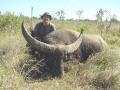
As we cautiously walked up to him I saw a big smile appear on Steve�s face. I knew this buffalo was a lot bigger than the others I had seen, but I just didn�t realize how big he really was. These animals can weigh as much as 2000 lbs. It is difficult to determine how much he weighed, but he was a lot bigger than the 9 ft brown bear I took in Alaska. Steve told me the horns would score around 100 inches. It wasn�t until we got back to camp that night and scored it out at 103 inches. Which if you�re using the Safari Club scoring method it would have scored in the gold medal range. I was very happy regardless of what is scored.
I spent the next two days of my trip fishing, looking for crocodiles and watching the ground in front of my feet as I walked. Steve has been a guide in Africa and in several other countries before setting up shop in Australia. He is an excellent guide, friendly to be around and most of all loves Americans. If you wish to book a hunt with Steve for Buffalo, Sambar Deer, Bangteng or a specialized trip or vacation in the outback contact me at [email protected] or at 989 344 9038. The best time to hunt in Australia is from June to Sept. The weather is a lot milder and the buffalo travel a great distance to feed off the fresh grass that grows after the control burns.
|